

Professional photography and video production in London can cost anywhere from a few hundred pounds to several thousand pounds depending on what you need, how the content will be used, how much planning is required, and how polished the final output needs to be.
That is the honest answer.
The less useful answer is: “It depends.”
Of course it depends. Everything depends. But if you are a business owner, restaurant, product brand, founder, agency, or marketing manager trying to plan a shoot, you need more than vague creative talk. You need to understand what you are paying for, what affects the price, and how to avoid wasting money on content that looks nice but does absolutely nothing for your business.
At ODGRAIN, we look at photography and video production differently. You are not just buying a photographer, videographer, camera, or editing timeline. You are buying visual assets that need to work across your website, social media, campaigns, menus, product pages, pitch decks, ads, and brand presence.
Because cheap content is only cheap until it makes your business look cheap.
So, How Much Does Photography and Video Production Cost in London?
In London, professional photography and video production costs vary depending on the type of project.
As a general guide:
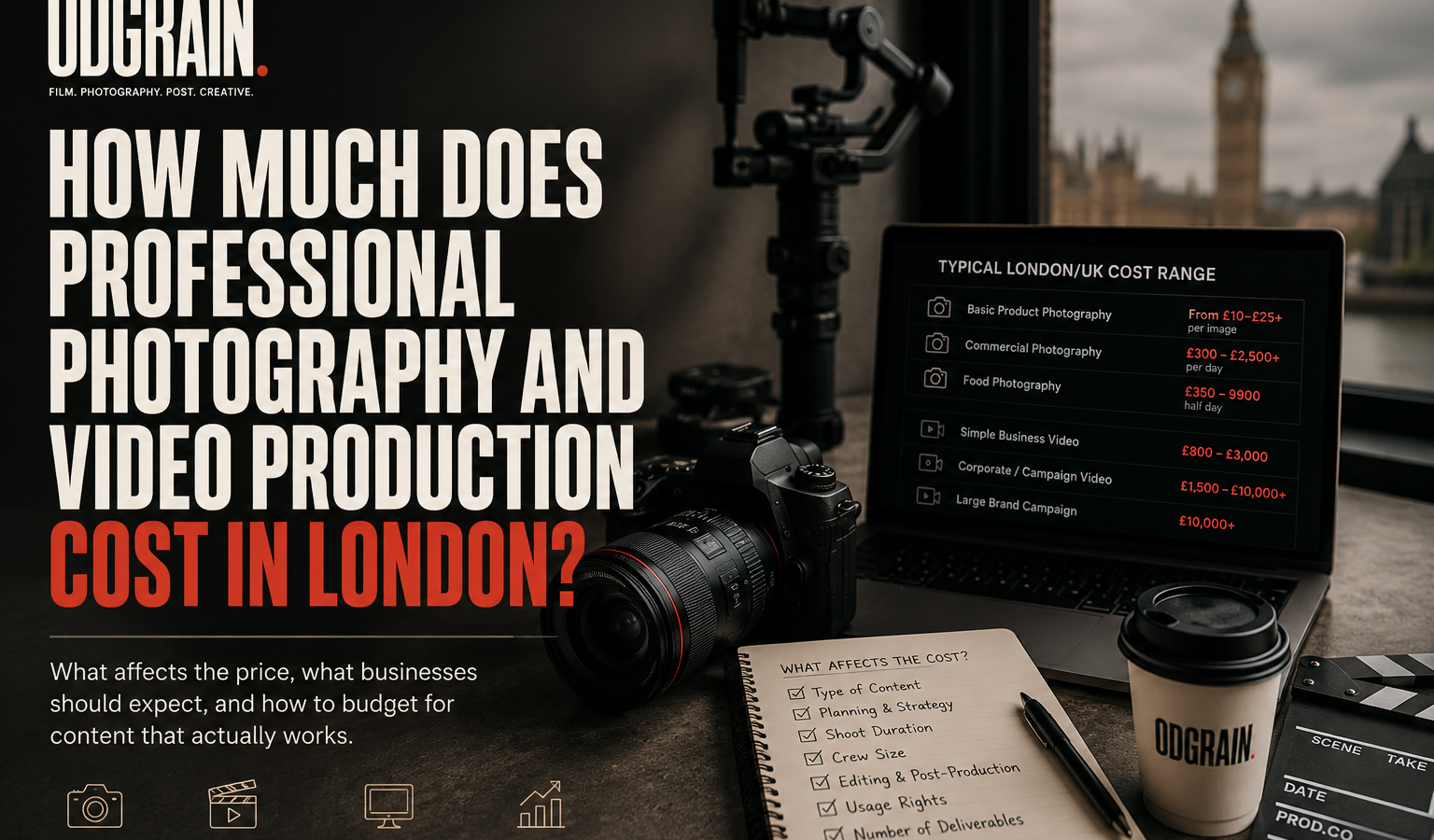
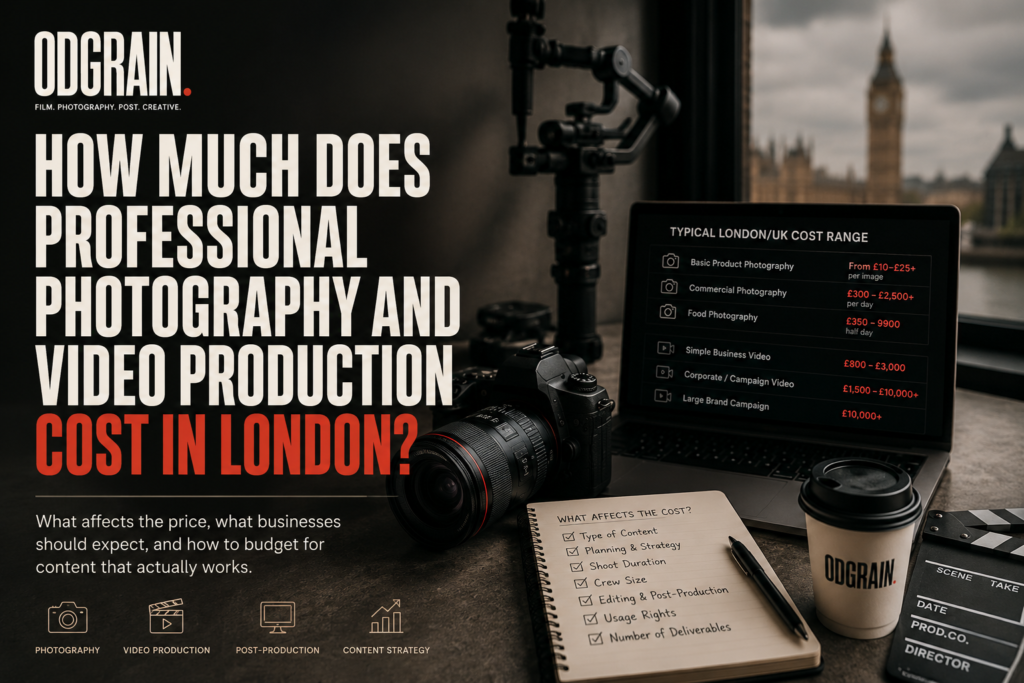
| Type of Work | Typical London/UK Cost Range |
|---|---|
| Basic product photography | From around £10–£25+ per image |
| Commercial photography | Around £300–£2,500 per day |
| Food photography | Around £350–£900 for a half-day, or £500–£1,500 for a full day |
| Simple business video content | Around £800–£3,000 |
| Corporate or campaign video production | Around £1,500–£10,000+ |
| Larger brand campaign production | Can go beyond £10,000 depending on scope |
These are not fixed ODGRAIN prices. They are general market ranges to help you understand what businesses usually pay for professional visual content in London and across the UK. Product photography studios may price simple e-commerce images per image, while commercial photographers often work on day rates. Video production can increase quickly once planning, crew, sound, lighting, editing, colour grading, motion graphics, and multiple deliverables are included.
But here is the important part:
The price is not just about the shoot.
The real cost depends on the outcome you want.
A few clean product photos for an online shop is one thing. A full content production day that gives you website images, social media videos, campaign assets, behind-the-scenes content, founder portraits, product close-ups, and launch visuals is a completely different job.
Same camera. Different strategy. Very different value.
What Actually Affects the Cost?
Most businesses make the mistake of asking, “How much for a photoshoot?”
That is the wrong question.
The better question is:
“What do we need this content to do?”
Because the cost of professional photography and video production in London depends on several key factors.
1. The Type of Content You Need
Different content types require different levels of planning, shooting, styling, and editing.
For example, a restaurant may need food photography, menu shots, team portraits, interior images, short-form videos, and behind-the-scenes kitchen content.
A product brand may need clean e-commerce images, lifestyle product photography, product demonstration videos, website banners, social media reels, and ad creatives.
A service business may need founder portraits, brand photography, office lifestyle shots, testimonial videos, educational short-form content, and campaign visuals.
Each type of content has a different purpose. And when the purpose changes, the production changes.
Simple packshots are usually cheaper because the setup is controlled and repetitive. Campaign content costs more because it needs creative direction, storytelling, lighting, shot planning, editing, and usage thinking.
2. The Amount of Planning Required
This is where cheap content usually fails.
A shoot without planning becomes a folder full of random files.
A shoot with strategy becomes a content system.
Planning can include:
- Creative direction
- Shot list development
- Moodboard creation
- Location planning
- Product preparation
- Styling direction
- Script or concept development
- Platform planning
- Content format planning
- Usage planning for website, social media, ads, and print
This matters because one well-planned shoot can produce content for weeks.
One badly planned shoot can produce 400 files you never use.
At ODGRAIN, we believe the planning stage is where the money is made. The shoot is just where the plan becomes visible.
3. Shoot Duration
A half-day shoot usually works for smaller projects with a focused shot list.
A full-day shoot is better when you need multiple setups, more variety, different locations, team involvement, video clips, or social content alongside photography.
Multi-day shoots are usually needed for larger campaigns, multiple locations, bigger teams, scripted videos, or brand launches.
But more time does not automatically mean better content.
A clear brief can make a half-day shoot more valuable than a full day of guessing.
4. Crew Size
Some projects only need one photographer or videographer.
Others may need:
- Photographer
- Videographer
- Creative director
- Assistant
- Food stylist
- Product stylist
- Sound operator
- Lighting assistant
- Editor
- Motion designer
Video production usually costs more than photography because it often needs more moving parts. Even a simple business video may involve camera, audio, lighting, editing, music, subtitles, colour correction, and multiple export formats.
That is why a one-minute video is not priced by “one minute of time.”
It is priced by everything required to make that one minute look intentional.
5. Editing and Post-Production
Post-production is where raw content becomes usable content.
For photography, this may include:
- Image selection
- Colour correction
- Retouching
- Cropping for different platforms
- Background clean-up
- Exporting for web and social media
For video, this may include:
- Footage organisation
- Editing
- Colour grading
- Sound clean-up
- Music licensing
- Captions
- Motion graphics
- Logo animation
- Multiple versions for Instagram, TikTok, LinkedIn, YouTube, website, or ads
This is one of the biggest pricing differences between “someone with a camera” and a professional content production team.
The shoot captures the ingredients.
Post-production cooks the meal.
6. Usage Rights
This is the part many businesses forget.
Where will the content be used?
A few Instagram posts? Your website? Paid ads? Packaging? Billboards? Delivery platforms? Investor decks? National campaigns?
The more commercially valuable the usage, the more important licensing and usage rights become.
For small businesses, usage is often simple. For bigger brands or paid campaigns, usage can affect pricing because the content has more commercial value.
Think of it like this:
A photo used once on Instagram is not the same as a photo used for a national advertising campaign.
Same image. Different value.
7. Number of Final Deliverables
A project that gives you 10 final edited photos is very different from a project that gives you:
- 40 edited photos
- 10 short-form videos
- 3 website banners
- 5 product close-ups
- 5 founder/team images
- 15 cropped social media assets
- 3 paid ad creatives
This is why asking for “a shoot” is too vague.
You need to know what you want to walk away with.
At ODGRAIN, we prefer building content around deliverables and business goals, not just time spent on set.
Photography vs Video Production: Which One Costs More?
Usually, video production costs more than photography.
That does not mean photography is less valuable. It means video often involves more layers.
Photography captures a moment. Video builds a sequence.
Video may require storyboarding, scripting, lighting, audio, multiple takes, editing, music, captions, grading, and different platform versions. UK video production guides commonly place professional video projects from around £1,500 into £10,000+ depending on complexity, while simpler social or interview-led videos may start lower.
But the smartest businesses do not choose one or the other.
They plan both together.
A strong production day can capture photography and video in one coordinated system. That means your brand does not just get a few nice photos. You get a content library.
And a content library is what feeds your marketing.
What Should a Small Business Budget?
For a small business in London, a realistic starting budget for professional visual content could be anywhere from £500 to £2,500 depending on what is included.
For example:
| Business Need | Sensible Budget Thinking |
|---|---|
| Simple product images | Lower hundreds to £1,000+ |
| Restaurant menu/content shoot | Around £600–£1,500+ |
| Brand photography session | Around £750–£2,000+ |
| Social media content production day | Around £1,000–£3,000+ |
| Short business video | Around £1,000–£3,500+ |
| Full campaign content package | £2,500–£8,000+ |
Again, these are planning ranges, not fixed quotes.
A bakery needing fresh menu photos and Instagram reels does not need the same budget as a tech brand launching a campaign video.
A founder needing LinkedIn content does not need the same production as a restaurant chain refreshing its full menu.
The right budget depends on the job the content has to do.
Cheap vs Professional: What Is the Difference?
Cheap content usually focuses on the task.
Professional content focuses on the outcome.
Cheap asks:
“How many photos do you want?”
Professional asks:
“Where will this content be used, who needs to care, and what action should it create?”
Cheap gives you files.
Professional gives you assets.
Cheap looks fine for a week.
Professional strengthens your brand for months.
This does not mean every business needs a huge production budget. It means every business needs to stop treating content like decoration.
Your visuals are often the first sales conversation your customer has with your brand.
Before they read your copy, they see your image.
Before they book a table, they see your food.
Before they enquire, they judge your credibility.
Before they buy, they decide if your brand feels worth trusting.
That judgement happens fast.
So the real question is not “Can I get this cheaper?”
The real question is:
“What is cheap content costing me in trust, attention, and missed sales?”
How to Get More Value From One Shoot
The smartest way to reduce content cost is not always to negotiate the cheapest price.
It is to make one shoot work harder.
Here is how to get more value:
Plan the Platforms First
Before the shoot, decide where the content will be used.
Instagram needs different framing from a website banner. TikTok needs different pacing from a LinkedIn video. A delivery app image needs different clarity from a lifestyle campaign shot.
Plan the platform before pressing record.
Build a Shot List
Do not rely on “we’ll see what happens.”
A shot list keeps the shoot focused. It also prevents missing obvious assets like team shots, close-ups, horizontal website images, vertical reels, process shots, and behind-the-scenes content.
Capture Photo and Video Together
Where possible, plan photography and video in the same production day.
For example, a restaurant shoot can capture:
- Hero dish photography
- Menu images
- Chef/team portraits
- Interior shots
- Pour shots
- Kitchen action
- Short-form reels
- Behind-the-scenes clips
- Website banner images
- Social media story assets
That is how one shoot becomes a full content engine.
Think in Campaigns, Not Posts
A single post disappears quickly.
A campaign creates momentum.
Instead of asking for “some content,” think in themes:
- New menu launch
- Product launch
- Founder story
- Seasonal campaign
- Brand refresh
- Customer experience
- Behind the scenes
- Before and after
- How it is made
This gives your content a reason to exist.
What Should You Ask Before Hiring a Photographer or Video Team?
Before hiring anyone for photography or video production in London, ask:
- Do they understand business content, or only visuals?
- Can they help plan the shoot?
- Do they provide creative direction?
- Will they think about social media formats?
- Can they shoot for website, ads, and social together?
- What exactly is included in editing?
- How many final assets will you receive?
- Are usage rights included?
- Do they understand your industry?
- Can they turn one shoot into multiple pieces of content?
The goal is not to find the cheapest person.
The goal is to find the person or team that makes your content useful.
Why ODGRAIN Approaches Pricing Differently
ODGRAIN is built around a simple belief:
Content should not just look good. It should work.
That means we do not treat shoots as isolated creative tasks. We look at what the business needs first, then build the content around that.
For some brands, that may mean a focused photography session.
For others, it may mean a full content production package with photography, video, post-production, and campaign assets.
We work across film, photography, post-production, and creative content because modern businesses do not need one nice photo.
They need a visual system.
A system that helps them look credible, show their product clearly, explain their offer, build trust, and stay visible online.
That is the difference between content creation and content production.
Final Thought: Do Not Pay for Content. Invest in Attention.
Photography and video production in London can look expensive when you see it as a one-day cost.
But when you use the content across your website, social media, campaigns, menus, ads, sales decks, and launch materials, the value changes.
A good shoot is not just a shoot.
It is brand trust.
It is better first impressions.
It is stronger marketing.
It is more content from less effort.
It is your business looking like it knows what it is doing.
And in a market where people judge fast, scroll faster, and forget instantly, looking average is expensive.
Need professional photography, video production, or content production in London?
ODGRAIN helps brands create visual content with purpose — from product photography and restaurant content to campaign assets, short-form video, and post-production.
Bring the product, the brand, or the idea.
We’ll help shape the visual system around it.
FAQs
How much does professional photography cost in London?
Professional photography in London can range from a few hundred pounds to several thousand pounds depending on the type of shoot, experience of the photographer, number of final images, editing requirements, and commercial usage. Commercial photography day rates in London can vary widely, with some published guides showing ranges from around £300 to £2,500 per day.
How much does video production cost in the UK?
Professional video production in the UK commonly starts from lower four figures and can increase to £10,000+ depending on the complexity of the project. Simple social or interview-led videos may cost less, while brand films, campaign videos, animations, and multi-location productions usually cost more.
Is photography cheaper than video production?
Usually, yes. Photography often requires fewer production layers than video. Video may involve scripting, sound, lighting, editing, music, captions, colour grading, and multiple format exports. However, the final price depends on the scope of the project.
What is included in a professional content production package?
A professional content production package may include creative direction, shot planning, photography, video, editing, retouching, colour grading, captions, social media exports, website assets, and campaign-ready deliverables.
Should my business choose photography or video first?
It depends on your goal. If your website, product listings, menu, or brand identity looks weak, start with photography. If you need engagement, storytelling, education, or campaign content, video may be stronger. For best results, plan both together so one shoot creates a full content library.
Why does professional content cost more than hiring someone with a camera?
Because professional content is not just about capturing images. It includes planning, direction, lighting, composition, editing, formatting, usage thinking, and making sure the final assets support your business goals.
How can I reduce the cost of photography and video production?
The best way to reduce cost is to plan properly. Build a clear brief, know your platforms, create a shot list, prepare products or locations in advance, and capture multiple types of content in one shoot.